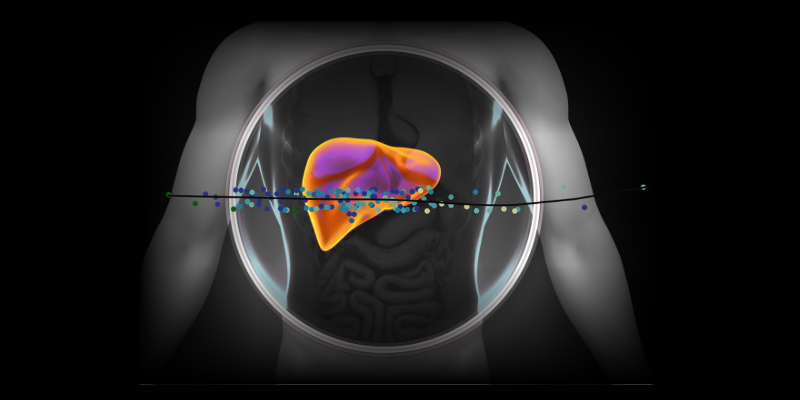
Molecular map of liver disease could transform how MASLD is diagnosed and monitored
14 July 2026
A new study establishes a molecular map of disease progression in Metabolic dysfunction-Associated Steatotic Liver Disease (MASLD), and identifies a set of blood biomarkers that could improve diagnosis.
Summary
- Scientists mapped the molecular progression of MASLD, uncovering how biological processes driving liver damage change over time, creating a framework for more precise stage-specific therapies.
- They identified a blood biomarker panel that predicts disease progression and outperforms current non-invasive diagnostic tools.
- The work establishes a framework for precision monitoring and future development of targeted therapies for chronic liver disease.
A study led by researchers at Open Targets, EMBL’s European Bioinformatics Institute (EMBL-EBI), the University of Cambridge, and others, has identified a set of plasma proteins that could be used to diagnose and monitor patients with Metabolic dysfunction-Associated Steatotic Liver Disease (MASLD). It was published today in Nature Metabolism.
A complex disease
MASLD, previously known as non-alcoholic fatty liver disease, is one of the leading causes of chronic liver dysfunction worldwide, affecting 1 in 3 adults. It is a progressive, chronic disease caused by an excess of fat in the liver, and encompasses a spectrum of conditions. In the UK, there are currently no approved medicines.
Most cases of MASLD are only diagnosed in the late stages. The gold standard for diagnosis is for a clinician to assess a liver biopsy under the microscope. This is invasive and can be subject to inter-observer variability. Although MASLD is a progressive disease, current diagnostics place patients into fixed stages based on how their liver looks under a microscope. This makes it hard to understand the molecular processes happening and how the disease actually works.
The new study integrates patient data to create a molecular disease trajectory, which identifies key sets of genes involved, and how their expression changes over the course of the disease at the population level. Using this, the researchers were able to place patients along the disease trajectory better than existing diagnostic tests.
A continuum of molecular changes
Another challenge to studying MASLD is that many factors affect disease progression, including biological sex and pre-existing conditions such as type 2 diabetes and heart diseases. This variability has made it difficult to study the baseline biological processes that characterise the disease, and create effective treatments.
In order to integrate multi-modal patient data, the researchers established a new methodology that anchors changes in gene expression to the histological changes that characterise MASLD progression and are common to all patients. By identifying the groups of genes significantly associated with histological changes, the researchers built a MASLD-related regulatory network from the bottom up, which captures both signalling pathway activities and cellular response patterns. In parallel, they used a histology-based patient ranking to stratify patients into sequential overlapping groups, to capture the continuous trajectory of the disease.
This provides a map of the genes involved in the disease, how their expression changes as the disease progresses and how different biological processes overlap and interact, such as inflammation or scarring of the liver tissue. It gives a more detailed view of how patients progress from one stage to the next, and how the liver cells change over the course of the disease. Where the researchers had access to repeated biopsies from patients over the course of the disease, the molecular trajectory shifts inferred by their framework tracked the real data over time.
“Describing MASLD as a series of distinct disease stages oversimplifies a highly dynamic disease,” said Ioannis Kamzolas, Postdoctoral Research Associate at the University of Cambridge and joint first-author. “By reframing MASLD as a continuous process, we were able to capture how the underlying biology evolves over time. We hope our framework will help drive a conceptual shift in how MASLD is studied and understood.”
Further research is needed to understand whether the genes they have found are causal or a consequence of the disease processes, but the trajectory provides a starting point to deciphering the mechanisms that underpin MASLD, which could lead to better treatments and diagnosis of patients.
Improving non-invasive diagnosis
To establish a set of diagnostic biomarkers, the team drew on previous research that uncovered proteins whose expression in blood plasma correlated to their expression in the liver1. The Open Targets team and colleagues found 57 genes present in both their MASLD dataset and this paired liver-plasma data, establishing a set of biomarkers that can be measured to predict where patients are in the disease trajectory. This biomarker panel outperformed existing non-invasive diagnostic tests, and could be used to complement and refine existing tests, or, pending validation, replace them.
“I was so surprised to see that biomarkers we identified based solely on the data were better at predicting patients’ disease stage than the state-of-the-art tests in the clinic,” said Evangelia Petsalaki, previously Group Leader at EMBL-EBI and the Open Targets project lead. “It’s also a strong argument to consider this approach for similar diseases, where it is hard to get repeated samples from patients.”
References
- Govaere, O. et al. A proteo-transcriptomic map of non-alcoholic fatty liver disease signatures. Nature Metabolism 5, 572 (2023).
Publication:
Kamzolas, I., Koutsandreas, T., et al. (2026) Decoding MASLD Progression: A Molecular Trajectory-Based Framework for Modelling Disease Dynamics. Nature Metabolism